Wednesday, February 16, 2011

Sio business dormitory


In 1899, the salt monopoly policy was implemented by Japanese Government in Taiwan and the Taiwan Monopoly Bureau was founded in 1901. In 1919, Taiwan Salt Manufacture Co. was founded for manufacturing salt exclusively in Taiwan and in 1922, the Anping office, one of the 4 salt factories in Tainan, was set up and a building complex including a salt making laboratory ,vacuum distillation factories, warehouses and a dormitory was built. The complex was used as a experimental salt factory and salt re-distributing office during Japanese colonial period and the vacuum distillated salt was the great achivement. The vacumn distillation factory was destroyed in WW II and the building was used as a dormitory by Taiwan Salt Co. Inc. retirees. The Ministry of Economic Affairs took back the building and recognized the deserted dormitory as a city grade historical site in 2003. A renovation project was started in 2008 and completed in February 2010. The building is now operating by Hwang Sun Enterprise Co. Ltd. under the BOT contract, called Sio Business Dormitory (Xi You Chu Zhang Suo, 夕遊出張所, as sio is the Japanese pronounciation for salt and Chu Zhang Suo is a business dormitory)

The architecture is a combination of Japanese and western styles. The 2 wooden buildings are connected with a roofed corridor in a formation of L shape. The roof of the entrance was built in hankirizuma-zukuri style; extending from the main building, a style of western balcony. The windows are counterpoised, you can easily stop the windows in any position. In the building, looking up, timbers were arranged in a crisscross pattern, a traditional Japanese roofing style; one room is elevated and covered with tatamis emitting a dense Japanese atmosphere.


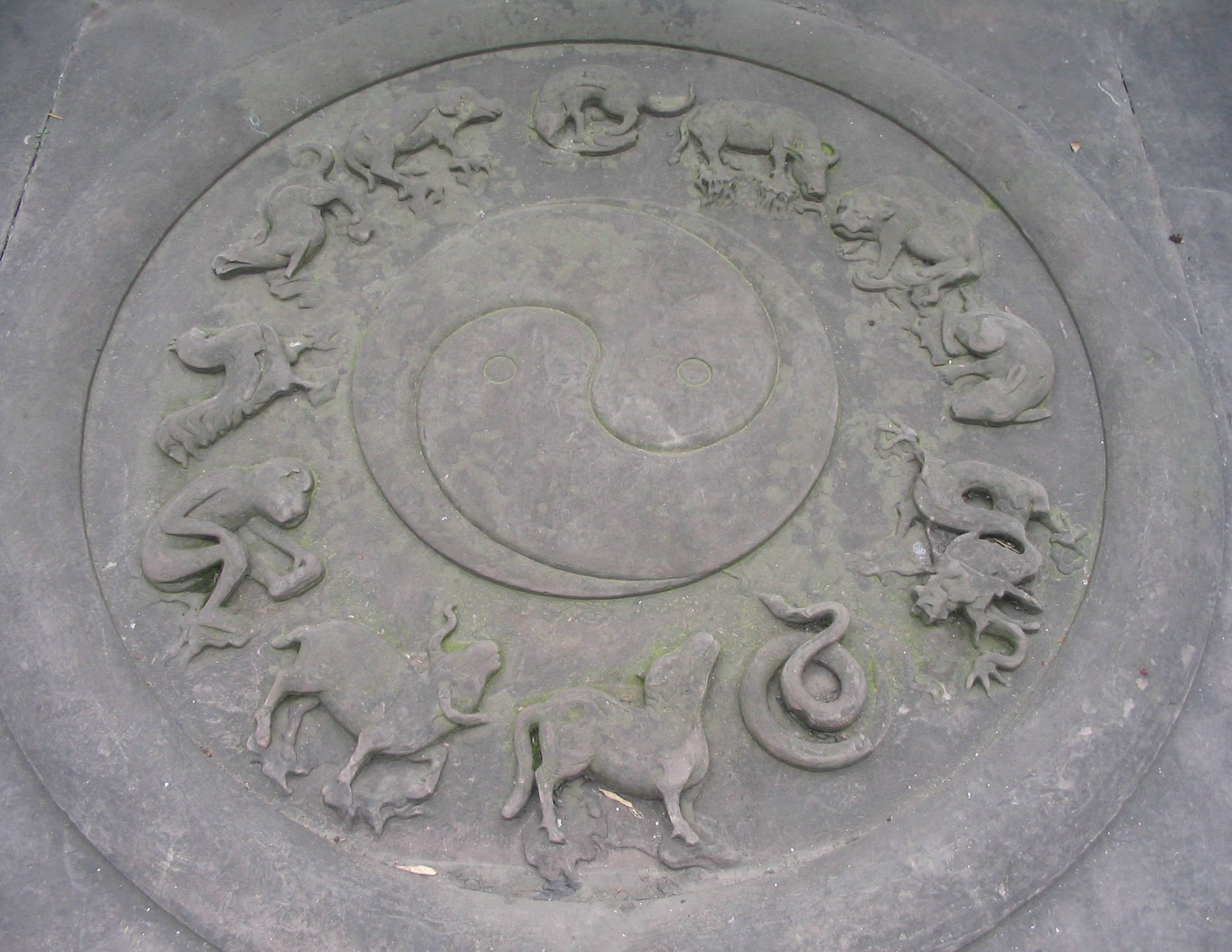
Given the history of the building, Sio business dormitory exhibits lots of salt sculptures in the room like the 12 Chinese Zodiac and Jadeite Cabbage with Insects.


366 different colored salt (one for Feb. 29th) is displayed in the lobby, you can find your birthday salt and a card explaining your characteristics.


Boiled egg is coated with white salt and shaped like a steam bun (NT$30).


Address: 196, Gubao St, Anping rd, Anping district, Tainan
Tel: 06-3911088
Opening hours: weekdays: 11:00-19:00; weekend: 10:00-20:00, Monday off.
Entrance is free

Sunday, February 13, 2011

Fo Guang Shan & Shen Wei Tian Tai Shan

During the Chinese New Year, I visited Fo Guang Shan and Shen Wei Tian Tai Shan I Kuan Tao. If you want to know more about Fo Guang Shan and I Kuan Tao , I embeded the links in the texts.

Happy Rabbit Year!!

Friday, February 04, 2011

Tai Sui Culture

By observing the position of stars in the sky, Chinese astronomers discovered the regular pattern of Jupiter moving about 30 degrees every year and it takes 12 years for it to finish a celestial circle (the orbital period of  Jupiter moving around the Sun is 12 years, 11.86 years to be exact). Based on this observation, Chinese astronomers divided the celestial circle into 12 sections called 12 Earthly Branches (地支) to follow the orbit of Jupiter. The ruling role of the Jupiter in ancient Chinese daily life was profound and it was recognized as the Year Star (Sui Xing, 歲星). However, Jupiter moves in a counterclockwise direction around the yellow belt (Yin direction) which is opposite from the habit used on Earth for direction. Chinese astronomers thus created a phantom star call Tai Sui (太歲) that moves in a direct opposite direction of Jupiter (in Yang direction (clockwise)) around the yellow belt with a cycle of 12 years. The twelve years of the Jupiter cycle not only identifies the phantom start "Tai Sui", but also provides the foundation of 12 Earthly Branches, the 12 Chinese Zodiac, the Chinese hour in the form of double-hours,12 directions, and the Chinese Sexagenary cycle, etc.

Tai Sui was considered as a guardian star that held the same standing as an emperor and the direction of Tai Sui was considered the direction of best luck. However, the prestige of Tai Sui is unchallengeable, the civilians don't have what it takes to get benefit from it; in contrary, it's advised to avoid facing it directly as it might offend the supreme star which could bring misfortune. It's the same idea that civilians couldn't look directly at the Emperor in ancient time. In time, the guardian role of Tai Sui was neglected and the evil influence prevailed.

Tai Sui was first recorded to be apotheosized in Eastern Han Dynasty (25–220 CE). It was until the Jin Dynasty, the Emperor Zhangzong (August 31, 1168 – December 29, 1208) started to worship his mother's natal star to pray for a fast recovery from her illness, the Tai Sui worshiping culture (An Tai Sui, 安太歲) got its popularity. Later on, 60 honorable generals were apotheosized as Tai Sui to assist the Jade Emperor (the king of all dieties) in taking charge of the well-being of the mortal world. Each of them takes turn to be in charge for a year; 60 generals (Tai Sui) match the 60 years of Sexagenary cycle.

The basic rule of An Tai Sui can be simplified as follows: each year, those whose Chinese Zodiacs are in alignment with Tai Sui/Jupiter are considered offending the Tai Sui (2 Zodiacs) while those whose Chinese Zodiacs form an angle of 45 degree from Tai Sui/Jupiter are considered conflicting the Tai Sui (2 Zodiacs). For example: this year, 2011, is a rabbit year, which means Tai Sui is orbitting upon the Rabbit Zodiac. Together with the Rooster (on the direct opposite direction of rabbit) are considered offending Tai Sui. Meanwhile, the Rat and Horse form an angle of 45 degree from the rabbit (where the Tai Sui is located) are considered conflicting Tai Sui (take a look on Tai ji and 12 Zodiacs pic for better understanding). It is advised those signs to go throught a prayer for blessing in avoidance of the evil influence of Tai Sui that might bring misforturne.

The An Tai Sui ceremony was as simple as writing down words like "The Tai Sui of this year is here" on a yellow or red paper and posted it on a wall then worshipped it with joss sticks twice a day through out the whole year. In the end of the year, the paper was torn down and burned. Nowaday, people go to temples around Chinese New Year (usually before January 15th of lunar calendar), pay some money (NT$600~1,200) and have the professionals say the prayer for them. In Taiwan, those whose Chinese Zodiacs offending/conflicting Tai Sui go to temples and write down their names and birthdays in lunar calendar (Gregorian-Lunar Calendar Conversion Table)(including the hour of birth). The information will be written on a piece of red paper and posted on a wall with a LED light lit up throughout the year (some have a buddha statu embeded in the wall). To identify the paper that has your name on it on a wall from hundreds of similar papers on it is not an easy task. The Tainan Kaiji Wu Temple (No.114, Xinmei St, Central-West District, Tainan city) introduced a system to help to locate your Tai Sui easily. You will be given a 6 digit number that is unique for your Tai Sui, keyin these digit on the locator, all LED lights on the wall will be switched off leaving only your light turned on for a while. Other temples also embrace modernization: you can pay the money via creadit card or even do it online.

Friday, January 21, 2011

Mukumugi & Taroko Gorge, Hualien

Taroko Gorge
Taroko National Park is one of the signature tourist attrations in Taiwan. It's located on the east end of the Central Cross-Island Highway (Provincial Highway No. 8) in Hualien, which was the first highway that connects east and west parts of Taiwan through the majestic central mountains. The budget used to build the Central Cross-Island Highway was funded by United States and the workers were veterans who fellback from mainland China to Taiwan with the Government in 1949. The construction began on July 7, 1956, and was first opened to traffic on May 9, 1960. The 190.83 kilometer highway passing through various topographies, altitude ranged from sea level to 3,000 meters and the most beautiful/majestic sceneries on the road are riveting for the last 20 km at the east end.

Most tourist groups spend only a half day in the park to visit Eternal Spring (Changchun) Shrine Trail,  Swallow Grotto (Yanzihkou) Trail and the Tunnel of Nine Turns (Jiuqudong) Trail. Everyday, after lunch, swarms of crowds diminish the stupendous workmanship of the trails. It is wise to visit these trails in the early morning when the solitude intensifies the majesty of the gorge and then you can really project yourself back to the time when the veterans doug through the marble of the mountainside. Except for the 3 most popular trails, Taroko National Park has much more to offer; you can easily spend a whole week hiking in the park on different trails as each trail has its uniqueness and it's a shame to miss one.

Recently, I spent 2 days in the park and finally visited the Shakadang Trail (4.4km/oneway; 3-4 hours/roundtrip) and Lüshui Trail (2km/oneway; one hour/roundtrip) for the very first time. A friend of mine once told me that she thought the Shakadang trail is the most beautiful trail in Taroko National Park. I have been to Taroko many times but I could never find the entrance of Shakadang trail so I stopped by the tourist center of Taroko and found the information: "The trail entrance is near the park headquarters to the west. Through the tunnel of Shakadang about 1km(0.6mile) from the headquarters, there is a Shakadang bridge connect to it. On the right of the bridge head, take the staircase down to the trailhead" (there is a small parking on the other end of the Shakadang bridge, you can park your car there and walk back to the entrance). Shakadang trail was built along the Shakadang river cliffs during Japanese colonial period in order to divert water to the Liwu hydropower plant. Thousands of years, the river cut through the gorge leaving mysterious patterns on marble that reflects on still, copper blue waters in a greenish background, such scenery earned the trail the name "Mysterious Valley Trail". I couldn't agree with my friend more, Shakadang is the most beautiful trail in the Park and it's worth spending 4 hours for a roundtrip.

The other new experience on this trip was the Lushui Trail. The history of the trail can be traced back 300 years. It was the trail used between Taroko tribes when they first settled along the Liwu river. Walking on this trail, high above the Central Cross-Island Highway, you can overlook the Lushui terrace. A suspension bridge, a tunnel with water dripping down, butterflies, bees, etc. along the way, it was an easy yet surprising trail.

More info:
Transportation: Tourist shuttle bus, Taroko route, (Time table and Fare Sheet)
Accommodation: Leader Village Taroko, Tienhsiang Youth Hostel, Silks Place Taroko, and a camping site at Lushui.
Resturant: Except for accommodation sites listed above, there are a few resturants next to the Tienhsiang bus station.

Mukumugi
Meqmegi was the name of the first Taroko tribal family who settled in this area about 300 years ago. To honor their ancestors, the tribes called this area "MGMGI" and was known as "Mukumugi", a transliteration from the Taroko tribe, by others. The place was renamed "Tongmen" (copper gate) as a copper mine was found here. Mukumugi is located in Tongmen township, Sioulin county, about 20 min driving distance from Hualien City. Compared to the famous Taroko National Park, Mukumugi is less known and visited by tourists as it was closed for public visit on May 20th, 2003 in order to restore the ecosystem. The area was re-opened 3 years later, with a 300 visitors/day restriction. The Mukumugi eco-tourism started to get the public's attention as the Taroko National Park is getting over crowded, day by day. Unlike the Shakadang trail in the Taroko National Park, Mukumugi not only offers a similar picturesque scenery but also a resort that allows vistors to have a close encounter with the nature.

More info:
Entrance permit application:
1. go to the Tongmen police station and fill-out the form on the day of entrance (ID needed); go early to ensure you are in the first 300 applicants list.
2. apply the permit online at http://eli.npa.gov.tw/E7WebO/index02.jsp (Chinese only): you should send out your application 7-30 days before your trip; 2-3 days after sending out the application, go back to the website and check if you get the permit. If you do, print it out and take it with you to the Tongmen police station on the day of your trip and have them stamp it (no queue with others who apply the permit on site).

Free tour guide: contact the Mukumugi tourist center in advance. (Tel :03-8641822) There are two trails in the Mukumugi area. One more difficult, requires a guide. Contact tourist center for more information.

Friday, December 24, 2010

Monday, December 06, 2010

Taitung & highway 9 and 11

The central mountains separate the east part of Taiwan from the west, leaving the east coast untouched from the modernization that changed green fields into skyscrapers. Eastern Taiwan is known as the Garden of Eden of Taiwan; It is also a place where over half the aborigines of Taiwan call home.

Taitung is located in south east Taiwan, a pit stop for travellers to Green Island and Orchid Island. Despite the fact that Han is the majority of demographic composition in Taitung city,  the city is the biggest aboriginal inhabitation in Taiwan. The biggest tribe in Taitung is the Ami (about 14000 people) followed by Puyuma (4000), Paiwan (1000), Rukai, and Yami etc. The various indigenous cultures make Taitung a great city for an aboriginal encounter. The main aboriginal festival, Malikoda, is held in July and August by Ami tribe, and the Mangayau, is held by Puyuma tribe in December. For details of aboriginal festival schedules and venues, visit Taiwan's Indegenous Peoples Portal (Chinese Only). Taitung is also one of the most important archaeological sites in Taiwan;  Changpin Culture, Chihlin Culture (Huge Stone Culture), and Peinan Culture are the 3 most important prehistory heritages found in Taitung. It is easy to spend 2 hours in the National Museum of Prehistory (opening hours: Tue-Sun, 09:00-17:00, NT$80/person (the ticket also gives you free access to Beinan Culture Park); audio guide avaliable for free rental / ID needed) where you can not only travel back to the prehistory  but also get to know the diversity of the Austronesian Cultures in Taiwan. The water fountain show of the museum is another attraction for visitors in Taitung, the schedules are 11:00-11:20, 17:00-17:20, and 20:00-20:40.

Except for cultural festivals, there are two distinct sceneries scattering along highway 9, the rift valley line, and highway 11, the coast line, from Taitung to Hualien. There are 3 routes of tourist shuttle buses that shuttle in between the tourist attractions in Taitung City (NT$100/person, unlimited access to all 3 routes on the purchase day). The rift valley route takes highway 9 stopping by Beinan Culture park, Endemic Plant Area, Chu Lu Ranch, and Lu Ye Hill etc; whereas the offshore island route takes highway 11 stopping by Forest Park, FuGang Fishing Harbor, Shiao Ye Liou, and Water Flowing Uphill etc. The 3rd tourist bus, Taitung City route, commutes between Taitung train station and Taitung airport stopping by Forest Park, Fruit Street, and National Museum of Prehistory etc. The 3 routes cover most of the tourist attractions in Taitung, however, to really enjoy the beauty of eastern Taiwan, I highly recommend to rent a car and take a few days driving along highway 9 or 11. Day lily sightings during late July to early October attract tourists to stay overnight on the mountains, to witness the moment when the golden hue of the flowers are brought up by the first ray from the Sun, spreading outward until the whole mountain is covered in a golden glow; hot springs wash away fatigue that was built up when driving in the wandering mountain roads and ranches make cowboy dreams come true for a day, etc; these are the excitments that highway 9 has to offer. Driving on highway 11, on one side the moutains are veiled occasionally by mists that makes the landscape look even more majestic and on the other side off the cliff, the waveless shimmering water of the Pacific Ocean contrasts the mercurial mountains making the name "Pacific" appreciated.

Useful websites:
Department of culture and tourism Taitung--the official tourisim website of Taitung.
East Rift Valley Natioanl Scenic Area-- Scenic spots along highway 9
East Coast National Scenic Area-- Scenic spots along highway 11
Wikitravel Taitung-- General information

Car rental tip:
The car rental services are mostly located in a walking distance of Taitung train station (car rentals in Taitung google map). The Union Car Rental has the best price. However, if you are planing to rent a car in Taitung and return it in other cities, you should stick with the HOTAI LEASING CORPORATION(HLC) as you don't have to pay an extra fee NT$1000-3000 if a reservation is made in advance.

A 3 days Itinerary:
Day 1: Visit Gao Tai Flying Sports Park in Lu Ye for sky diving -> lunch at Taitung Yuan Sen Applied Botanical Garden--taste organic vegetables hot pot -> Chu Lu Ranch for a walk -> Beinan Culture Park -> National Museum of Prehistory -> water fountain show at 20:00 -> check in to Aboriginal Culture Hotel (cheap and clean but NO air conditioning)

Day 2: Dulan Sugar Factory -> Water flowing uphill -> Shiao Ye Liu -> Fugang Fishing Harbor for seafood lunch -> Zhiben Forest Recreation Area -> check in one of the hot spring hotels.

Day 3: Day lily sighting on Jean Zen mountain in Taimali (late July  to early October only) -> Taitung Forest Park bicycle riding (you can rent the bicycle at the Taitung Aboriginal Culture Hotel) -> Taitung Railway Art Village.

Monday, November 29, 2010

Green Island

Green island (綠島, Lyu dao) is a small vocanic island located about 33km off the eastern coast of Taiwan. The island was originally inhabited by Ami aborigines who called it Sanasai, meaning the birth place of ancestors. A fisherman, Chen bi Xian, who led the village from Xiao Lu Chou first settled down on the island in 1803 and the Han immigration started. The island was called "Huo Shao Dao" (fire-burned island) in the begining of 19 century (Chin Dynasty) and renamed "Green Island" by the magistrate of Taitung in 1949. There are several versions of stories about how the island was called fire-burned island including the residents would light up torches on the hill of the island to guide fishing boats to a safety return before there was a light house; a wild fire burned down the half island; and the red soil was exposed because the vegetation on the island was destroyed by typhoon in summmer or cold fronts in the winter time creating an illusion from the distance.

Surrounded by Pacific Ocean, the island is an ideal isotated spot for outlaws, and the island was noted as a place that held the most dangerous exiles of Taiwan. There were two prisons on the island: the Green Island Prison that used to lock up the most brutal gansters is still functioning as a prision today; the Green Island Lodge where most of the political prisoners were held during the white terror is now opened to the public for visit.

Green island has one of the three sea bed hot springs in the world (one in Japan and the other in Italy) that attracts a lot of sea bed hot spring afficionado worldwide. The hot spring is located in a tidal flat, in the eastsouth of the island, a perfect spot for sunrise. Sitting in the ocean and feeling the heat of the hot spring surrounding you as the first ray of sun appears is a unique experience.

Except for the sea bed hot spring and exotic vocanic landscape, the underwater world is the jewel of green island. There are over 300 different species of coral in green island including a 13 meter tall Porites lobata that has lived in the Shrlang area for over 1200 years. Every summer the black current brings many different species of fish to the area making it the high season for tourism.


Video by Yang Zhe Ren, National Museum of Marine Biology & Aquarium.

Transportation:
To the island:
By ferry: NT$ 920/person for a return ticket. Take a ferry at Fugang harbor in Taitung City, check in 30min before departure. You can find the schedule and book a ticket online at http://www.ezboat.com.tw/  (Chinese only).
By air: NT$ 1028/person for an one way ticket. Take a plane at the Taitung airport;  there are 3 flights a day by daily air;  flight schedule.

On the island:
Motocycle is the best transportation to move around the island, NT$350/day, or you can take one of the tourist buses that depart at 08:00, 09:00, 10:00, 11:00, 14:00, 15:00, 16:00 and 17:00 at the Nanliao Harbor. The bus clockwisely circumnavigates the island, it also makes brief stops at  tourist attractions of the island and the bus final stop is the Nanliao Harbor. It takes about 2 hours for a bus trip, NT$100/person. ( for details call 089-671272)

Accommodation:
There are a lot of B&B on Green Island, most of them provide a package tour (about NT$2000 to 250 per person) including one room, green island return tickets, motocycle, snorkeling/ glass boat/ hot spring, night tour for wild sika deer sighting, etc. you can find out more by surfing the B&B info in the following websites:
http://www.gbnb.com.tw/
http://www.yoyogreenisland.com.tw/

Diving:
http://diving.okgo.tw/
http://blog.yam.com/black481861
http://www.089672010.tw/